

Prerequisites
Before starting, ensure you have:- GCP Project with billing enabled, sufficient quotas, and required GCP APIs enabled
-
VPC and subnet: a custom VPC with a runner subnet. The runner subnet hosts both the runner service and environment VMs. Internal load balancers require additional subnets.
Optional: Private Google Access. If your runner subnet does not have external internet access, enable Private Google Access on the subnet so VMs can reach GCP services through Google’s internal network. See GCP services and APIs required for the full list of services that need to be reachable.
- Domain name that you control with DNS modification capabilities
-
SSL/TLS certificate with Subject Alternative Names (SANs) for both the root domain and wildcard:
yourdomain.comand*.yourdomain.com. Storage location depends on your load balancer mode. - Terraform >= 1.3 and gcloud CLI installed and authenticated
Create runner in Ona
- In the Ona dashboard, go to Settings → Runners and click Set up a new runner
- Select Google Cloud Platform as the provider
- Enter a name and click Create
Terraform module setup
Create a directory for your runner configuration and set up the following files.main.tf references the Ona Terraform module with a GCS backend for state storage:
Using a GCS backend stores your Terraform state remotely, enabling team collaboration and protecting against local state loss. Create the bucket beforehand with versioning enabled.
variables.tf declares input variables. Add optional variables from the advanced configuration section as needed:
terraform.tfvars contains the values from the Ona dashboard and your GCP project. See the sections below for the full variable reference.
Required configuration variables
These variables are required for every GCP Runner deployment. Most of them are pre-filled in the Terraform configuration example shown in the Ona dashboard after you create the runner.Core Authentication Variables
These values are provided by the Ona dashboard when you create the runner.The
api_endpoint value is provided in the Ona dashboard when you create the runner. If your organization uses a custom domain, the endpoint will reflect that domain instead.GCP Project and Location
Specify the GCP project and region where the runner infrastructure will be created.Network and Ingress Configuration
Configure how inbound and outbound traffic reaches your runner by specifying your VPC, subnet, and load balancer settings.
The runner subnet hosts both the runner service and environment VMs. Recommended CIDR:
/16 for non-routable ranges (large deployments) or /24 minimum for routable ranges.
External Load Balancer (Default)
Internal Load Balancer
certificate_secret_id must point to a Google Secret Manager secret containing both the certificate and private key as a JSON object:
gcloud, replacing the paths with your certificate and key files:
Advanced configuration
The settings below are for organizations with additional network or security requirements, such as corporate proxies, private CAs, encryption key management, or restricted IAM policies. Most deployments do not need these.HTTP Proxy Configuration
For environments behind corporate firewalls:Custom CA Certificate
If your network uses a corporate proxy or internal services with certificates signed by a private Certificate Authority, configure the runner to trust your CA certificate:
Provide either
file_path or content, not both.
This is commonly needed alongside HTTP Proxy Configuration when the proxy performs TLS inspection with a corporate CA.
Customer-Managed Encryption Keys (CMEK)
For compliance with organizational encryption policies:For additional configurations when using pre-existing CMEK keys, refer to the IAM configuration guide in the Terraform module.
Cross-Zone Restart
Enable cross-zone restart if stopped dual-disk environments should be able to restart in another zone when the original zone has no VM capacity. When enabled, the runner makes a stopped dual-disk VM eligible for deletion after a 10-minute grace period instead of the default 4 hours. The runner preserves the detached data disk and creates a Compute Engine image backup after detachment. A same-zone restart reattaches the disk. If that zone has no VM capacity and the backup is ready, the runner can recreate the data disk in another zone. Existing disk snapshot backups remain restorable, but the runner creates new backups as Compute Engine images.This option requires Terraform module v2.0.3 or later. Existing deployments keep their current behavior unless you enable it.
Pre-Created Service Accounts
By default, the Terraform module creates and manages three service accounts for the runner components:
If your organization requires service accounts to be created externally (e.g., by a central IAM team), you can provide pre-created service accounts instead. The module skips creating each supplied service account and uses the one you provide.
By default, your IAM team must assign the custom roles, general project-level roles, and
roles/iam.serviceAccountUser policies. Set attach_iam_policies to true to let the Terraform module manage those permissions. This mode requires the Terraform deployer to have permission to create custom roles and update IAM policies, but the IAM team only needs to create the service accounts.
attach_iam_policies defaults to false. You can provide a subset of the service accounts. The module creates any account left empty. See the IAM configuration guide for the roles required by each mode.Custom Images
Some enterprise networks do not allow pulling container images from external registries. In these cases, you can point the runner at images hosted in your own internal registry.If you must use custom images, set up an automated pipeline to sync images from Ona’s stable channel to your internal registry (e.g., Artifactory). The sync must preserve the source OCI manifest digest. A mirror that rewrites the manifest or copies different bytes cannot complete an automatic runner update. Contact Ona support for guidance on image synchronization and release notifications.
Shared VPC
If your organization uses a GCP Shared VPC where the VPC is hosted in a separate host project, setvpc_project_id to the project that owns the VPC. When omitted, the module assumes the VPC is in the same project as the runner (project_id).
Project Metadata Mode
By default the module usesgoogle_compute_project_metadata, which is authoritative and removes any project metadata keys not declared in the module. Set use_authoritative_project_metadata = false to use per-key google_compute_project_metadata_item resources instead, which only manage enable-oslogin and gitpod-runner-id.
Migrating an existing deployment
Migrating an existing deployment
Before applying with Replace
use_authoritative_project_metadata = false on an existing deployment, migrate the Terraform state:<PROJECT_ID> with your GCP project ID. Adjust the module path if yours differs from ona_runner.Labels
Apply GCP labels to all resources created by the module. Labels are useful for cost attribution, filtering in billing reports, and organizational policies.Deploy
Initialize Terraform to download the module, then validate, plan, and apply:Post-deployment
Afterterraform apply completes, retrieve the load balancer IP and configure DNS:
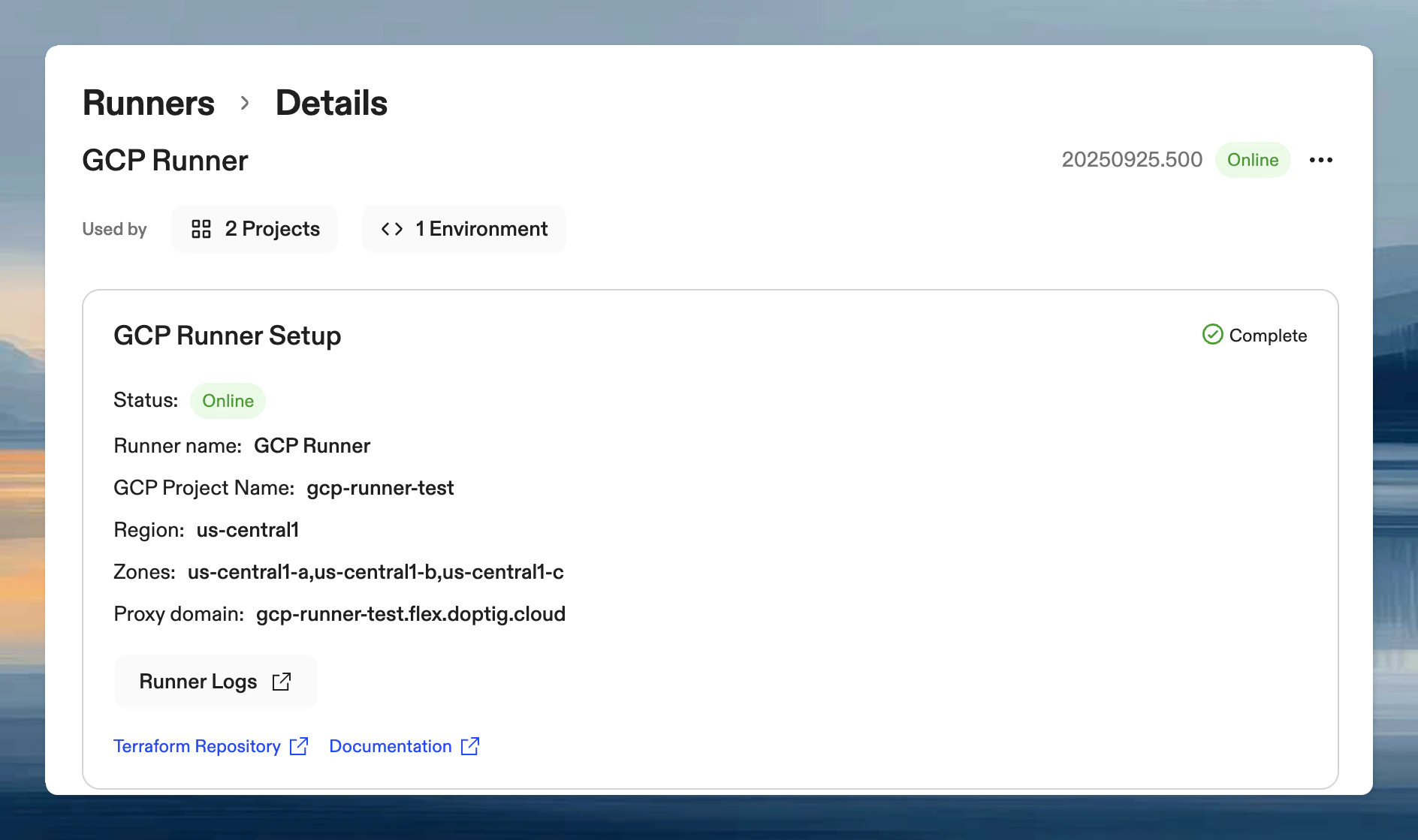
Next steps
With your GCP Runner successfully deployed and verified:- Configuring Repository Access - Set up access to your Git repositories and authentication
- Private GAR Images - Configure access to private Google Artifact Registry
- Model access - Configure supported OpenAI model access for Codex Agent on this runner
- Troubleshooting Guide - Troubleshooting and monitoring guide